We are excited to share a new article in ACS Sensors: “A Point-of-Care System for the Quantification of Small-Molecule Drugs in Blood.”
The publication describes a rapid point-of-care platform for measuring clinically relevant small-molecule drugs in blood. It brings together assay chemistry, antibody-DNA conjugation, fluorescence detection, blood filtration, cartridge design and a compact optical reader – all with the goal of producing a quantitative result within 10 minutes.
For us at MedicQuant, this paper is particularly special. It captures an early but important stage of the technology’s development and laid much of the scientific groundwork for the assay platform we continue to improve today.
Why measure small-molecule drugs at the point of care?
Drug concentration can matter a great deal when clinicians need to make urgent treatment decisions.
One important example is the measurement of direct oral anticoagulants, or DOACs, in patients arriving with acute stroke, major bleeding or a need for urgent surgery. Existing quantitative methods often depend on central laboratories and may take too long when every minute matters. Mass spectrometry is highly accurate but requires specialised equipment, while coagulation-based tests typically involve laboratory infrastructure and longer turnaround times.
Small molecules are also difficult targets for conventional immunoassays. Unlike larger proteins, they are usually too small for the familiar “sandwich” format in which two antibodies bind the same target. The platform described in the paper therefore uses a competitive assay design.
How does the assay work?
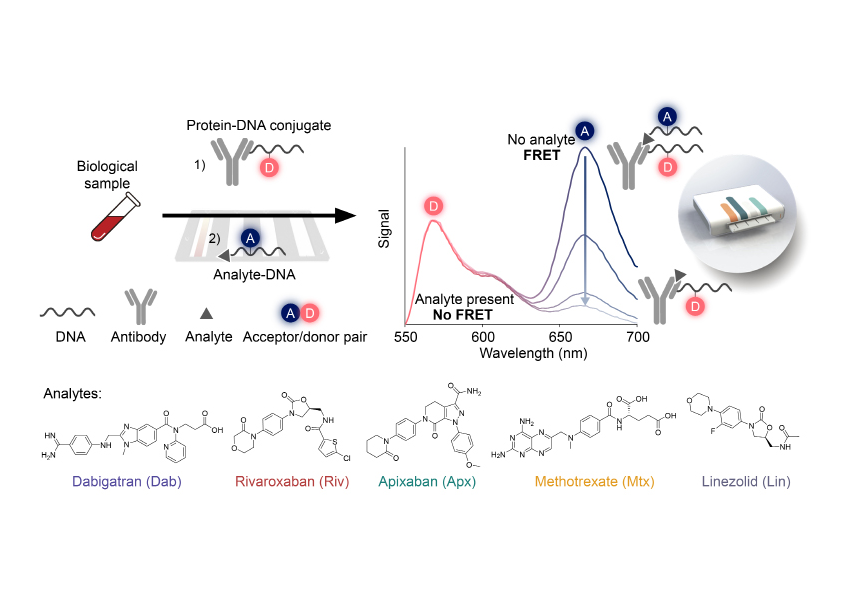
At the heart of the system is a homogeneous immunoassay based on Förster resonance energy transfer, better known as FRET.
The assay contains an antibody or antibody fragment connected to a Cy3 donor fluorophore, together with a DNA-linked version of the target drug carrying a Cy5 acceptor fluorophore.
When little or no free drug is present in the sample, the labelled drug analogue binds to the antibody. This brings the two fluorophores close together and produces a strong FRET signal.
When more free drug is present, it competes for the antibody-binding sites. Less of the labelled analogue can bind, and the FRETsignal decreases. The signal can therefore be related to the concentration of drug in the sample.
DNA plays several useful roles in the system. It provides a controlled linker between antibodies, drug analogues and fluorophores, helps with purification and solubility, and supports the rapid reconstitution of dried reagents inside the cartridge.
Because the assay takes place entirely in solution, it does not require surface-bound capture reagents, washing steps or enzymatic amplification. This makes the workflow faster and simpler while still allowing sensitive, quantitative detection.
From assay chemistry to a complete cartridge
A clever assay is only useful at the point of care if the surrounding workflow is simple.
In the published system, the assay reagents are dried at different positions on a porous filter inside a disposable cartridge. When blood is added, the filter retains the red blood cells while allowing a plasmafront to move through the cartridge by capillary action.
As the plasma moves forward, it reconstitutes there agents in sequence. It first encounters the antibody–DNA conjugate, allowing the drug in the sample to bind. It then reaches the labelled drug analogue, completing the competitive assay.
The plasma and assay components then flow into a small integrated micro cuvette, where the optical measurement takes place. A compact reader excites the donor fluorophore and measures both donor and acceptor emission, allowing the FRET signal to be followed in near real time.
This flow-front design combines blood separation, reagent handling, mixing and optical readout in one small cartridge – without centrifugation or manual pipetting.
Tested across five different drugs
The platform was demonstrated for five clinically relevant small molecules:
Dabigatran, rivaroxaban and apixaban, which are anticoagulants; methotrexate, used in oncology and other therapeutic areas; and linezolid, an antibiotic.
The anticoagulant assays were tuned for low-nanomolar sensitivity, while the methotrexate and linezolid assays were adjusted for higher concentration ranges. The dynamic range could be modified by changing the amount of antibody conjugate used in the assay, showing that the same basicplatform could be adapted to different drugs and clinical concentration ranges.
Measurements were completed in approximately five minutes for plasma and 10 minutes for whole blood. The integrated assays showed strong dose-response behaviour, with good linearity across the relevant measurement ranges.
Comparing the system with established laboratory methods
The dabigatran assay was also evaluated using 52 clinical plasma samples.
Its results were compared with LC-MS/MS, as well as established coagulation-based methods for a subset of the samples. Overall, the point-of-care system showed performance comparable to conventional laboratory assays, with no evidence of systematic deviation across the measured range.
The study also highlighted areas for further work, including testing larger clinical cohorts and expanding validation in fresh whole-blood samples. That is an important part of translating a promising laboratory concept into a dependable clinical tool.
And this was only the beginning
This publication documents many of the ideas that shaped MedicQuant’s technology: competitive FRET detection, antibody-DNAconjugates, dried reagents, sequential reagent release and cartridge-based optical measurement.
Since the work described in the article was completed, our team has put tremendous effort into improving the platform further – making it more robust, practical and better suited for real-world clinical use.
We are proud to see this foundational work published and grateful to the researchers, clinicians, engineers and collaborators who helped bring together the many pieces required to make the system work.
Publication: A Point-of-Care System for the Quantification of Small-Molecule Drugs in Blood
Journal: ACS Sensors
DOI: 10.1021/acssensors.6c00741
Published: 2 July 2026.

.jpeg)